
Why 'Explainable AI' Is Not the Same as Attribution in Financial Crime
Aug 18
/
Claudia Haberland
Here’s the reality for anti-money laundering (AML) teams today: you can have the most transparent, interpretable machine learning model on the market, and it still won't tell you who is actually attacking your institution.
As financial institutions race to adopt AI, "Explainable AI" (XAI) has become a favorite buzzword. Vendors proudly show how their models arrive at a risk score, pointing to feature weights like transaction velocity, round-dollar amounts, or sudden changes in account activity. But explaining why an algorithm flagged an artifact is fundamentally different from attributing a behavioral pattern to a named adversary.
As financial institutions race to adopt AI, "Explainable AI" (XAI) has become a favorite buzzword. Vendors proudly show how their models arrive at a risk score, pointing to feature weights like transaction velocity, round-dollar amounts, or sudden changes in account activity. But explaining why an algorithm flagged an artifact is fundamentally different from attributing a behavioral pattern to a named adversary.
To understand why this distinction matters, we look to the framework laid out in Section 2’s whitepaper on Hybrid Threat Finance™.
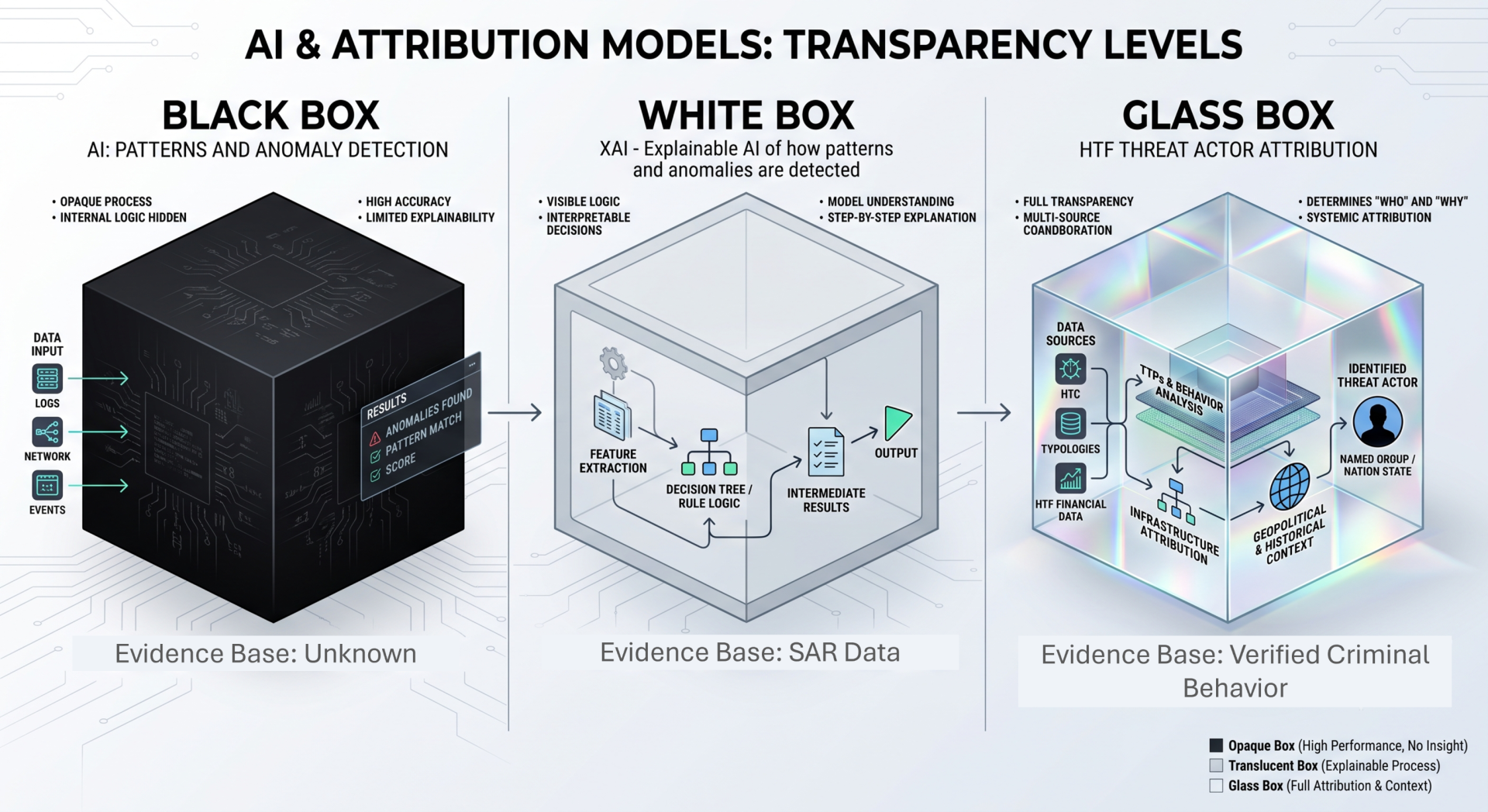
Explainable AI Explains the Model, Not the Threat
Standard Explainable AI operates on mathematical features extracted from individual transactions or small account clusters. When an XAI system flags an account, it might tell an analyst:
"This alert fired because the account received three cash deposits just below $10,000 within 48 hours, originating from a high-risk ZIP code."
That explanation is useful for validating model mechanics, but structurally, it remains trapped at the bottom of the analytical chain. It explains the algorithm's logic regarding disposable artifacts.
As Section 2 points out, a transaction or account is a cheap, disposable artifact. Adversary networks can rotate accounts in days, shell entities in weeks, and single transactions in seconds. Scoring and explaining those artifacts is like analyzing individual snowflakes with extreme precision while the snowstorm continues to bury your team.
XAI answers: "Why did the machine flag this data point?"
It does not answer: "Who is running this operation, and what business model does it serve?"
"This alert fired because the account received three cash deposits just below $10,000 within 48 hours, originating from a high-risk ZIP code."
That explanation is useful for validating model mechanics, but structurally, it remains trapped at the bottom of the analytical chain. It explains the algorithm's logic regarding disposable artifacts.
As Section 2 points out, a transaction or account is a cheap, disposable artifact. Adversary networks can rotate accounts in days, shell entities in weeks, and single transactions in seconds. Scoring and explaining those artifacts is like analyzing individual snowflakes with extreme precision while the snowstorm continues to bury your team.
XAI answers: "Why did the machine flag this data point?"
It does not answer: "Who is running this operation, and what business model does it serve?"
How Section 2 Frameworks True Attribution
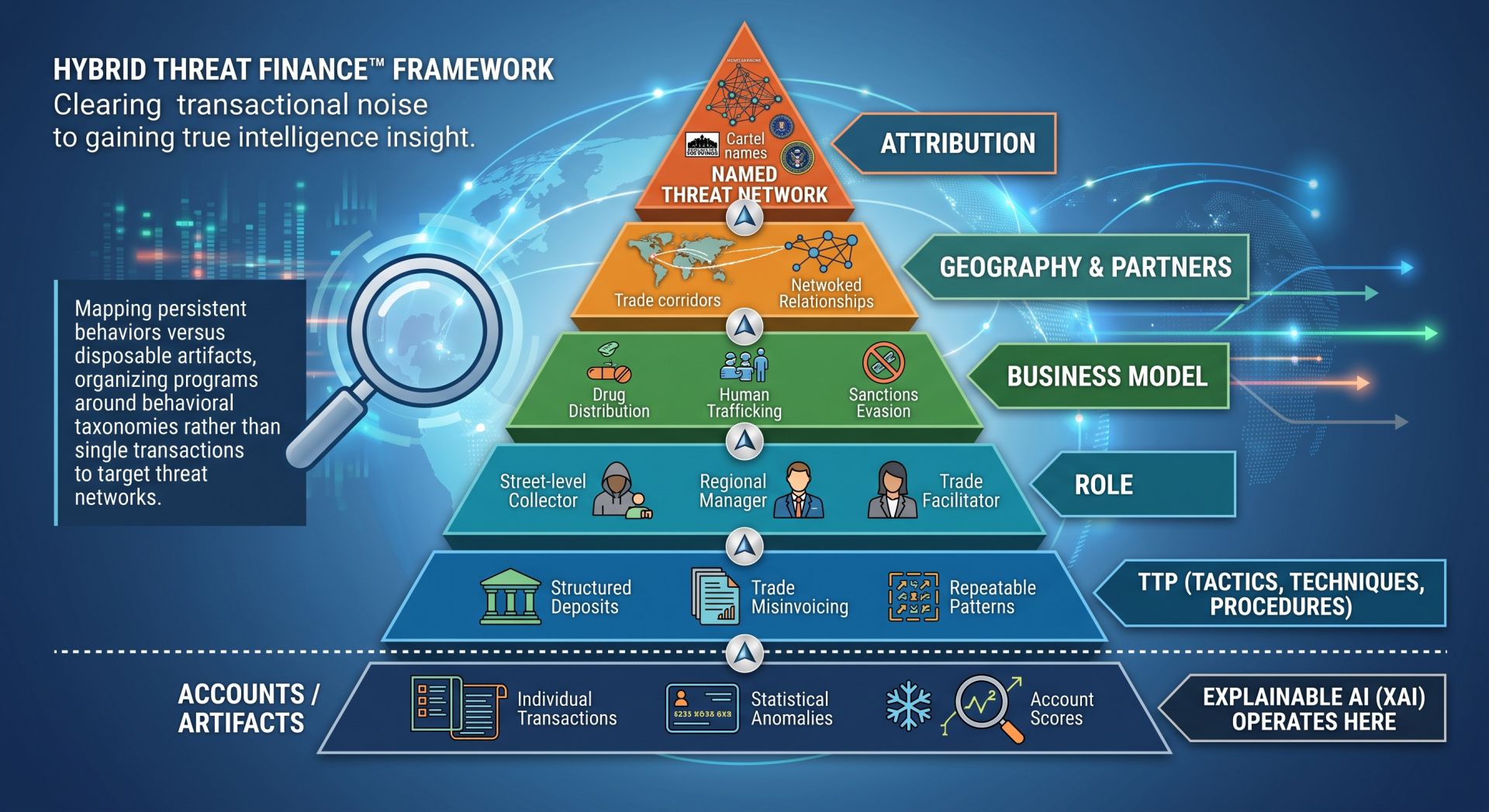
While XAI breaks down why an artifact reached a certain threshold, Section 2’s HTF framework places that activity inside a five-stage financial lifecycle, spanning from originating revenue generation down to operational sustainment. A cash deposit at placement looks operationally different from a deposit supporting network sustainment (like payroll or logistics), even if standard ML algorithms view them as identical transaction anomalies.
Attribution requires shifting the unit of analysis away from disposable artifacts and moving up to persistent behaviors. Section 2 adapts cybersecurity’s proven model, David Bianco’s Pyramid of Pain and the MITRE ATT&CK framework, to build a dedicated taxonomy for financial crime called Hybrid Threat Finance™ (HTF).
Instead of focusing on what single transaction occurred, Section 2 maps Tactics, Techniques, and Procedures (TTPs) across an upward-resolving hierarchy:
Observed Behavior: The specific TTP seen in the queue (e.g., structured merchant deposits or trade misinvoicing).
Actor Role: Identifying whether the footprint belongs to a street-level collector, a regional manager, or a trade facilitator.
Business Model: Contextualizing the revenue line driving the activity (e.g., drug distribution vs. human trafficking vs. sanctions evasion).
Geography & Partners: Sharpening the behavioral fingerprint using known trade corridors and partner networks.
Named Network: Resolving the chain up to the actual adversary enterprise, such as a specific transnational cartel or state-sponsored entity.
Attribution requires shifting the unit of analysis away from disposable artifacts and moving up to persistent behaviors. Section 2 adapts cybersecurity’s proven model, David Bianco’s Pyramid of Pain and the MITRE ATT&CK framework, to build a dedicated taxonomy for financial crime called Hybrid Threat Finance™ (HTF).
Instead of focusing on what single transaction occurred, Section 2 maps Tactics, Techniques, and Procedures (TTPs) across an upward-resolving hierarchy:
Observed Behavior: The specific TTP seen in the queue (e.g., structured merchant deposits or trade misinvoicing).
Actor Role: Identifying whether the footprint belongs to a street-level collector, a regional manager, or a trade facilitator.
Business Model: Contextualizing the revenue line driving the activity (e.g., drug distribution vs. human trafficking vs. sanctions evasion).
Geography & Partners: Sharpening the behavioral fingerprint using known trade corridors and partner networks.
Named Network: Resolving the chain up to the actual adversary enterprise, such as a specific transnational cartel or state-sponsored entity.
While XAI breaks down why an artifact reached a certain threshold, Section 2’s HTF framework places that activity inside a five-stage financial lifecycle, spanning from originating revenue generation down to operational sustainment. A cash deposit at placement looks operationally different from a deposit supporting network sustainment (like payroll or logistics), even if standard ML algorithms view them as identical transaction anomalies.
The Operational Difference in the Queue
Confusing explainability with attribution is one reason global AML detection rates have hovered around a dismal 1% for two decades. Current systems generate alerts at rates that exceed analyst capacity by roughly 50:1, leaving teams drowning in explainable, yet un-actionable, transactional noise.
Feature
Unit of Analysis
Primary Output
Analyst Question
Regulatory Impact
Explainable AI
(XAI)
Single transactions, account scores, statistical anomalies.
Feature importance values (e.g., SHAP/LIME outputs, risk weights).
"Why did the software score this transaction high?"
Helps defend model logic during routine audit checks.
Adversary Attribution (HTF)
Behavioral patterns, TTPs, and threat network signatures.
Named Hybrid Threat network, actor role, business line, and corridor.
"Which adversary is executing this business model, and in what role?"
Meets FinCEN's Effectiveness mandate by producing actionable SARs for law enforcement.
Moving Beyond Model Transparency
Explainable AI is a necessary engineering step for auditing models, but it is not a threat intelligence strategy. Knowing that an algorithm added 20 points to a risk score because of a wire transfer's size doesn't give law enforcement anything actionable.
True attribution shifts the conversation from clearing alert queues to exposing named adversary networks. By organizing defensive programs around behavioral taxonomies rather than disposable artifacts, financial institutions can finally stop scoring snowflakes and start mapping the storm. If we want to make a genuine difference in combatting financial crime, we need to change how we target it; because at the end of the day, you cannot identify that which you have not defined, and you cannot define that which you have not observed.
True attribution shifts the conversation from clearing alert queues to exposing named adversary networks. By organizing defensive programs around behavioral taxonomies rather than disposable artifacts, financial institutions can finally stop scoring snowflakes and start mapping the storm. If we want to make a genuine difference in combatting financial crime, we need to change how we target it; because at the end of the day, you cannot identify that which you have not defined, and you cannot define that which you have not observed.
La Threat Finance Academy de la Sección 2 es la división de educación en delitos financieros de la Section 2, Inc., redefiniendo cómo las instituciones financieras detectan y desarticulan el crimen financiero a través de una formación basada en inteligencia.
Policy Pages
© 2026 Section 2 • Threat Finance Academy • All rights reserved
CE Accreditation in progress · section2.com